
 Back to resources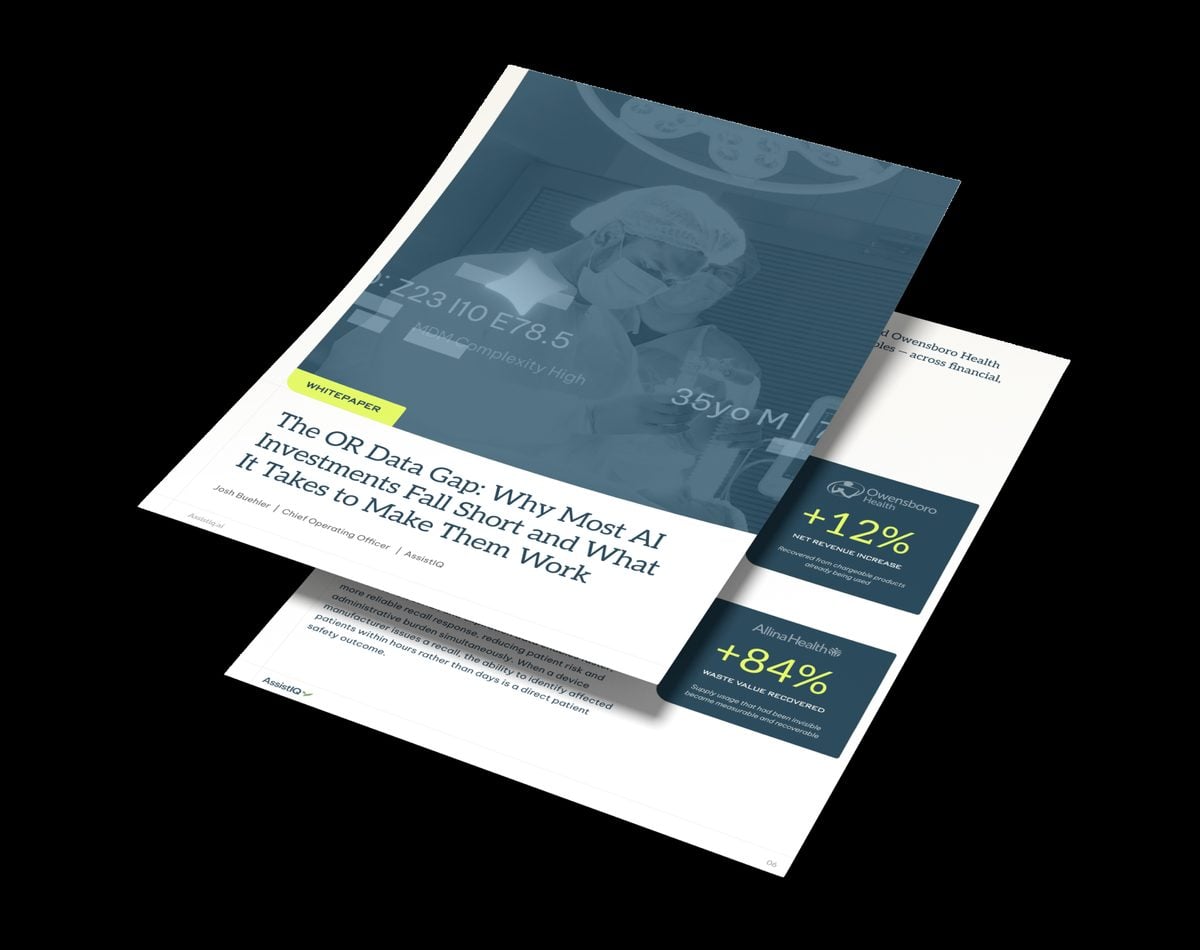
Surgical services generate up to 70% of a hospital’s total revenue. And yet the data used to manage them routinely tells an incomplete story.
That gap — between what happens in the OR and what gets documented — is the subject of a new whitepaper AssistIQ wrote for OR Manager: “The OR Data Gap: Why Most AI Investments Fall Short and What It Takes to Make Them Work.” It’s written for perioperative, supply chain and financial leaders who have invested in efforts to improve implant, tissue and supply usage data and are still waiting for the returns to fully materialize.
The documentation gap is bigger than most organizations realize
Circulating nurses are responsible for capturing supply, implant, and tissue usage in real time, while also managing patient safety, sterility, and room turnover. When a case demands full clinical attention, documentation is often the first thing that slips.
Research puts the intraoperative documentation error rate as high as 17% under normal conditions. When entry is delayed more than 20 minutes, that rate climbs to 38.4%. Every undocumented item is an unbilled charge, and that gap compounds quietly across every case. Across health systems AssistIQ has partnered with, we have observed error rates as high as 50% in workflows still reliant on manual documentation. Every undocumented item is an unbilled charge, and that gap compounds across every case.
Adding more tools and workflows has not solved it
Health systems have deployed barcode scanning, RFID, and automated charging systems with genuine intent to fix this. The challenge is that these tools add steps to a workflow already operating at capacity. When a scan fails or a case demands full attention, the step gets skipped. Many teams maintain parallel paper-based processes as a hedge, doubling the burden rather than reducing it – sometimes making those initiatives counterproductive.
The whitepaper examines why this pattern repeats,what it costs when it does, and why computer vision capture – technology that documents what happens in the OR without adding to the clinical team’s workload – represents a fundamentally different starting point
What closing the gap makes possible
Early deployments of AssistIQ at health systems such as Allina Health and Owensboro Health show what becomes possible when the foundation changes. The whitepaper walks through what those organizations achieved across financial, clinical, operational, and workforce dimensions, and includes a practical four-question framework for evaluating any capture solution before you invest.
Read “The OR Data Gap” and get the framework.